API Governance as a Business Lever
In a microservices world, APIs are contracts. They define how services communicate and how teams collaborate. Poorly governed APIs create duplication and risk; well-governed APIs unlock reuse, accelerate delivery, and drive business agility.
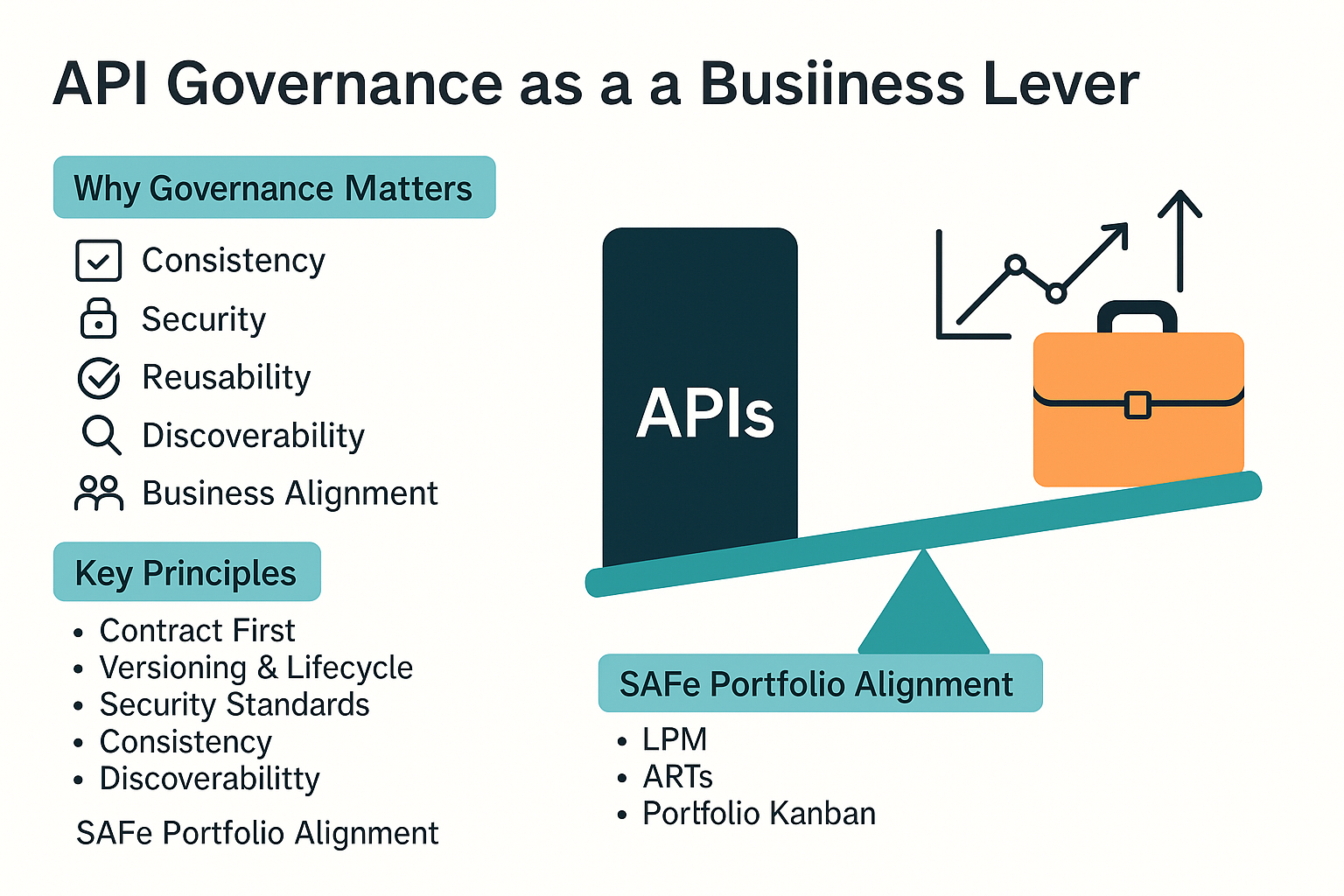
Why Governance Matters
- Consistency: predictable design conventions.
- Security: standardized authentication and authorization.
- Reusability: avoids duplication across teams.
- Discoverability: APIs as shared assets in catalogs.
- Business Alignment: APIs tied to product lines and value streams.
Key Principles
- Contract First: design APIs before coding (OpenAPI, AsyncAPI).
- Versioning & Lifecycle: backward compatibility and deprecation timelines.
- Security Standards: OAuth2, JWT, and compliance enforcement.
- Consistency: naming conventions, verbs, error handling.
- Discoverability: central catalogs and documentation portals.
Governance Models
- Centralized: strong consistency but risks bureaucracy.
- Federated: autonomy for teams, but risks drift.
- Hybrid (recommended): central guardrails + team autonomy.
SAFe Portfolio Alignment
In SAFe, API governance is embedded in enablers and guardrails:
- LPM: funds API modernization as strategic enablers.
- ARTs: deliver APIs aligned with value streams.
- Portfolio Kanban: tracks API epics and enablers.
Anti-Patterns
- Shadow APIs: undocumented and hidden endpoints.
- Inconsistent Security: multiple standards across services.
- API Sprawl: duplication from lack of discoverability.
- Rigid Bureaucracy: governance so heavy it slows innovation.
Business Outcomes
- Faster delivery: reuse instead of rebuild.
- Lower cost: less duplication and rework.
- Improved security: consistent enforcement.
- Agility: services can be recombined into new products quickly.
Key Takeaway
API governance is a business enabler. With lightweight guardrails, organizations gain speed with safety. SAFe portfolios ensure APIs are funded, governed, and treated as strategic assets.