Domain Teams & Bounded Contexts
When organizations adopt microservices, they often start by decomposing code. But the real transformation happens when team structures and business portfolios are aligned to those services. This is where bounded contexts and SAFe’s project portfolio framework come together to ensure microservices deliver business outcomes, not just technical artifacts.
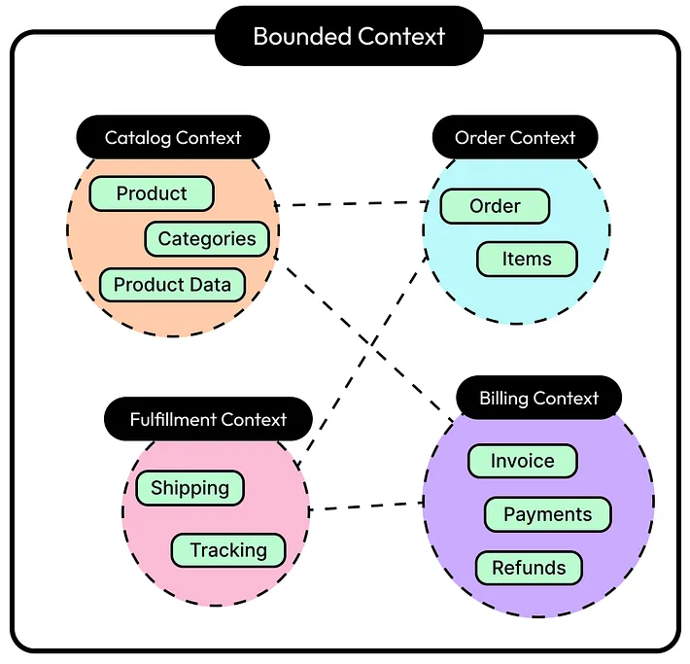
Domain Teams & Bounded Contexts
A domain team owns a specific business domain (checkout, billing, inventory). A bounded context defines the scope where a model applies consistently. In microservices, each context maps to services that encapsulate business logic, APIs, and data.
SAFe Portfolio Alignment
SAFe provides governance and investment models that strengthen bounded context adoption:
- Lean Portfolio Management (LPM): funds value streams instead of siloed projects.
- Agile Release Trains (ARTs): align multiple domain teams under shared business objectives.
- Value Streams: connect services to measurable KPIs like time-to-market or revenue impact.
Alignment Patterns
- Team-per-Context: one team owns one domain context.
- Multi-Context ARTs: several bounded contexts grouped under one ART.
- Shared Platform Contexts: centralized platform services (auth, observability) enable autonomy.
Governance in Practice
Bounded contexts + SAFe portfolio structures ensure:
- Funding flows to value streams, not projects.
- ARTs coordinate execution across related domains.
- Portfolio Kanban makes investment flow visible.
Business Outcomes
When teams own bounded contexts and portfolios align funding:
- Direct strategic alignment between architecture and business investment.
- Faster time-to-market through independent domain releases.
- Reduced duplication and service sprawl.
- Resilience through isolation of failures at the domain level.
Key Takeaway
Microservices succeed not by being small, but by being aligned with business domains. Bounded contexts provide clarity, while SAFe portfolios ensure governance and funding alignment. Together, they turn microservices into a business-aligned operating model.