Service Ownership Models
Microservices deliver agility when each service has a clear owner. Without ownership, services drift, documentation fades, and dependencies multiply. Ownership is not just technical — it’s organizational, cultural, and strategic.
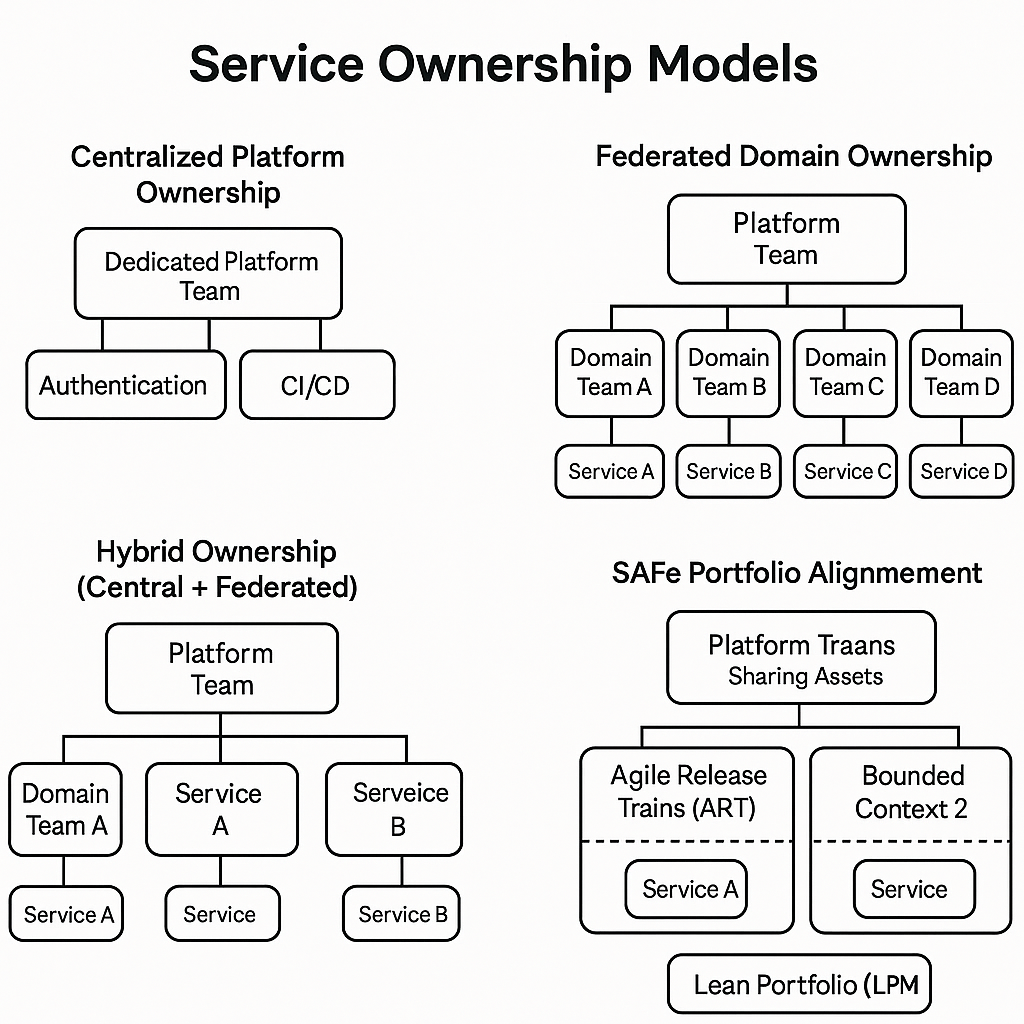
Centralized Platform Ownership
A dedicated platform team owns cross-cutting services like authentication, observability,
CI/CD, and compliance. They provide the foundation but do not deliver direct business features.
✅ Best for enterprise-wide capabilities that must remain uniform.
Federated Domain Ownership
Each domain team owns its services end-to-end: APIs, data, and lifecycle.
Services align to bounded contexts and business goals.
✅ Best for business-aligned services where agility matters most.
Hybrid Ownership (Central + Federated)
A hybrid model combines central ownership of platforms with federated ownership of domain services.
Clear contracts define where responsibilities begin and end, balancing speed + control.
✅ Best for scaling organizations balancing autonomy with safety.
SAFe Portfolio Alignment
Service ownership maps directly into SAFe portfolio structures:
- Platform Teams: support multiple value streams with shared assets.
- Agile Release Trains (ARTs): federated teams own bounded context services.
- Lean Portfolio Management (LPM): directs investments to both shared enablers and domain-specific services.
Anti-Patterns to Avoid
- Orphan Services: no clear owner, abandoned after delivery.
- Shadow Ownership: multiple teams modifying the same service.
- Over-Centralization: bottlenecks from too much control in one team.
- Over-Federation: chaos and inconsistency with no shared standards.
Business Outcomes
Clear ownership models ensure:
- Reliability: accountability improves uptime and SLAs.
- Efficiency: reduced duplication and waste.
- Speed: innovation accelerates with autonomy.
- Governance: lifecycle and compliance built into the model.
Key Takeaway
Microservices thrive when ownership is intentional. Whether centralized, federated, or hybrid, clear accountability ensures microservices become an operating model for agility and resilience.