✔ Activities and Ceremonies Framework 👈
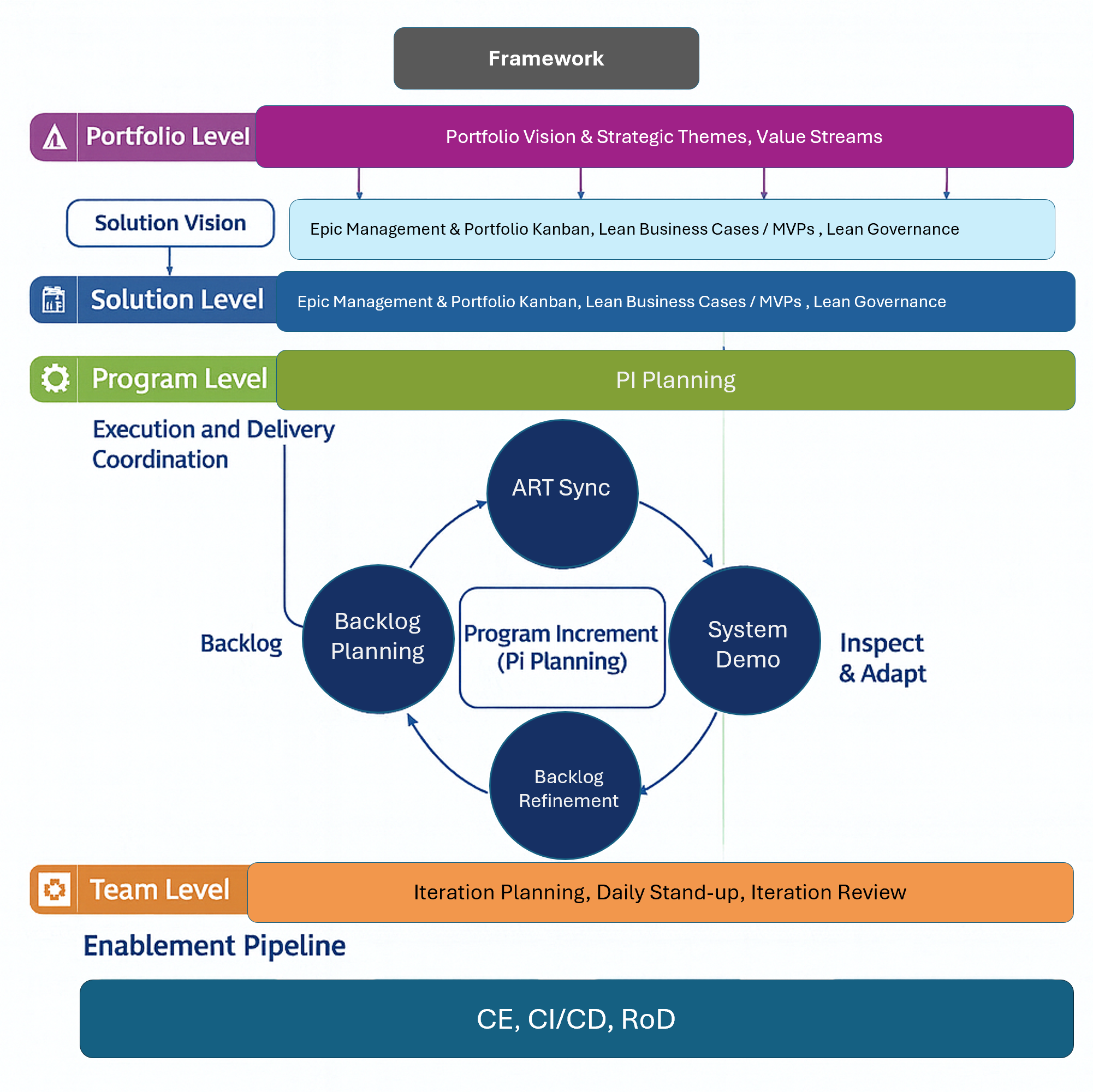
🔍 Overview
The Scaled Agile Framework (SAFe) defines synchronized ceremonies and events at every organizational level—ensuring alignment, flow, and continuous improvement. These structured activities enable enterprises to deliver value predictably, adapt quickly, and continuously improve across all levels of scale.
🏛️ Portfolio Level
Aligns business strategy with execution through Lean governance and funding mechanisms.
- Strategic Themes: Define direction and connect enterprise strategy to execution.
- Portfolio Vision: Describes desired future state and solution outcomes.
- Portfolio Kanban: Manages flow of Epics from ideation through completion.
- Lean Portfolio Management (LPM): Aligns strategy, funding, and execution.
- Portfolio Sync / Review: Inspects performance, progress, and alignment.
- Participatory Budgeting: Collaborative funding allocation across value streams.
Portfolio ceremonies ensure strategic alignment and value realization across the enterprise ecosystem.
🚆 Solution Level
Coordinates multiple Agile Release Trains (ARTs) building large, integrated solutions.
- Solution Vision: Outlines the end-state vision for the integrated solution.
- Solution Intent: Documents both solution behavior and implementation details.
- Pre-PI & Post-PI Planning: Synchronize ARTs and suppliers before and after PI Planning.
- Solution Train Sync: Reviews progress, dependencies, and risks across ARTs.
- Solution Demo: Demonstrates integrated capabilities delivered by the Solution Train.
Solution-level events align multiple ARTs to deliver cohesive, large-scale system value.
🎯 Program Level (ART Level)
Synchronizes planning, execution, and learning across teams within the Agile Release Train (ART).
- PI Planning: Aligns teams on a common mission and objectives for the upcoming increment.
- ART Sync (RTE-led): Combines Scrum of Scrums and PO Sync for cross-team coordination.
- System Demo: Demonstrates integrated work from all teams every iteration.
- Inspect & Adapt (I&A): Concludes each PI with reflection, metrics, and improvement actions.
Program-level ceremonies maintain alignment and visibility across the ART to ensure reliable value flow.
👥 Team Level
Focuses on Agile team iteration cadence, execution, and continuous improvement.
- Iteration Planning: Team commits to goals and defines work for the iteration.
- Daily Stand-up: Brief team sync for status updates and impediment identification.
- Iteration Review: Showcases completed work to stakeholders.
- Iteration Retrospective: Reviews successes and identifies improvement opportunities.
- Backlog Refinement: Prepares stories for future iterations and maintains flow readiness.
Team-level ceremonies sustain predictability, foster accountability, and build momentum within each sprint cycle.
⚙️ Continuous Delivery Pipeline
Enables continuous flow of value from ideation to release through automation and collaboration.
- Continuous Exploration (CE): Defines what to build via innovation, market sensing, and design thinking.
- Continuous Integration (CI): Ensures frequent integration and automated testing of all code changes.
- Continuous Deployment (CD): Automates the release process to deliver frequently to environments.
- Release on Demand: Provides the capability to release value when business and customer needs align.
The pipeline bridges development and operations, enabling rapid feedback and market responsiveness.
✅ Key Outcomes
- Organizational alignment across strategy, execution, and improvement.
- Predictable, synchronized value delivery across Agile Release Trains.
- Continuous flow of value supported by automation and feedback loops.
- A culture of relentless improvement and collaboration across all levels.