✔ Metadata Narrative: Ea‑2‑Sa Enterprise Architecture Governance Tool 👈
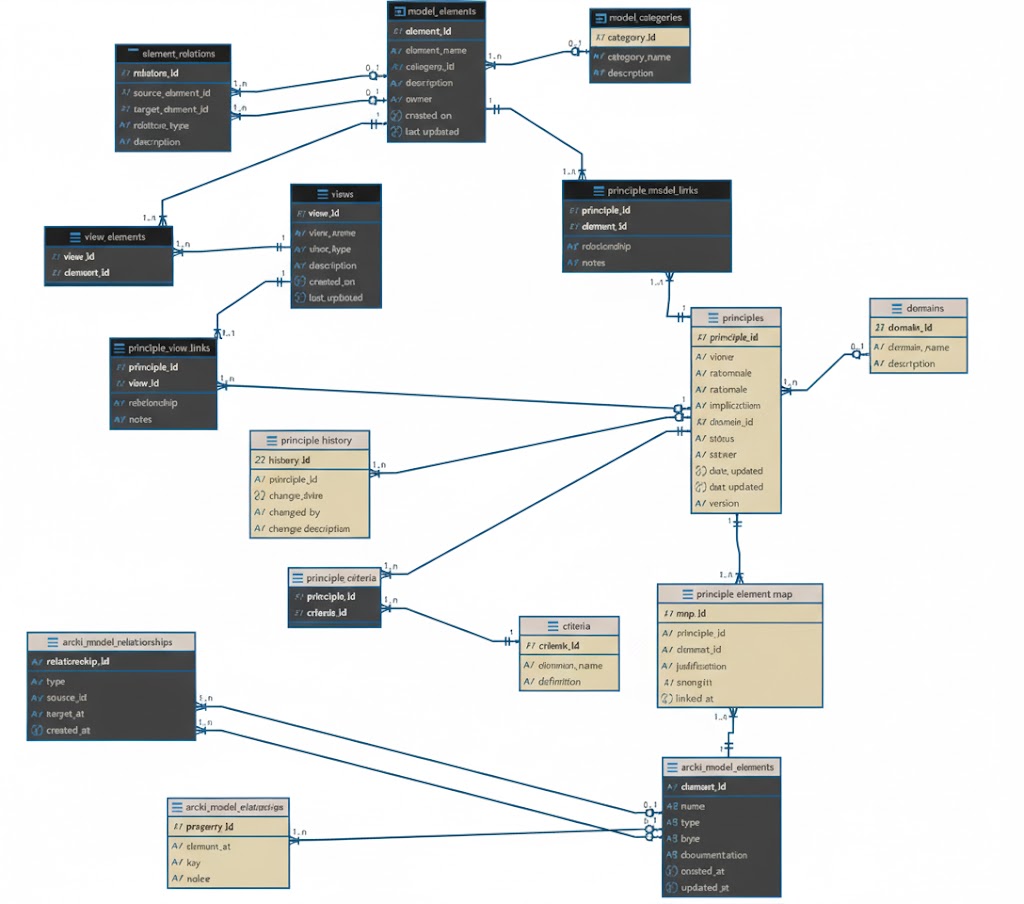
The Ea‑2‑Sa Governance Tool implements a tightly integrated data model that captures the full lifecycle and operational context of enterprise architecture principles. It is designed to make principles actionable, traceable, and enforceable through linked architecture elements, decision workflows, and visual models.
1. Central Registry of Architecture Principles
At the core is the principles table, which stores each architectural principle’s statement, rationale, implications, versioning, domain classification, and owner metadata. This is the single source of truth for governance.
2. Hierarchical Classification and Criteria Alignment
Supporting structures like domains, criteria, and principle_criteria allow principles to be evaluated against business-aligned factors. This enables multi-dimensional assessment for architecture review boards.
3. Historical Traceability
Changes to any principle are recorded in principle_history, supporting audits, version control, and continuous improvement.
4. Principle-Element Mapping
The principle_element_map allows mapping principles to archi_model_elements and other artifacts using justification and strength fields. These relationships drive traceability between architectural decisions and governed constraints.
5. Visualization and Viewpoint Integration
The views, view_elements, and principle_view_links tables enable principles to be linked directly to viewpoints and architecture models for real-time contextual relevance.
6. ArchiMate-Driven Modeling
ArchiMate modeling is fully supported via the archi_model_elements, archi_model_properties, and archi_model_relationships tables. Principles can govern visual artifacts, layered designs, and decision flows.
7. Semantic and Relational Mapping
The schema supports generic modeling via model_elements, model_categories, and element_relations—creating a hybrid semantic layer for business, technical, and conceptual governance.
8. Decision Workflows and Board Integration
The principle_model_links table connects principles directly to model elements for use in architecture reviews, governance processes, exception handling, and decision documentation.