✔ The Next Frontier in Governance Automation 👈
🔑 Executive Summary
In a world of accelerated software delivery, cloud-native infrastructure, and constantly shifting regulation and threat landscapes, traditional governance and compliance methods are no longer sustainable. Policy as Code (PaC) represents the next evolution — embedding governance directly into the DevOps pipeline.
Just as DevOps blurred the lines between development and operations, PaC merges governance and automation, ensuring that compliance and risk controls move at the same velocity as the code itself.
📘 What Is Policy as Code?
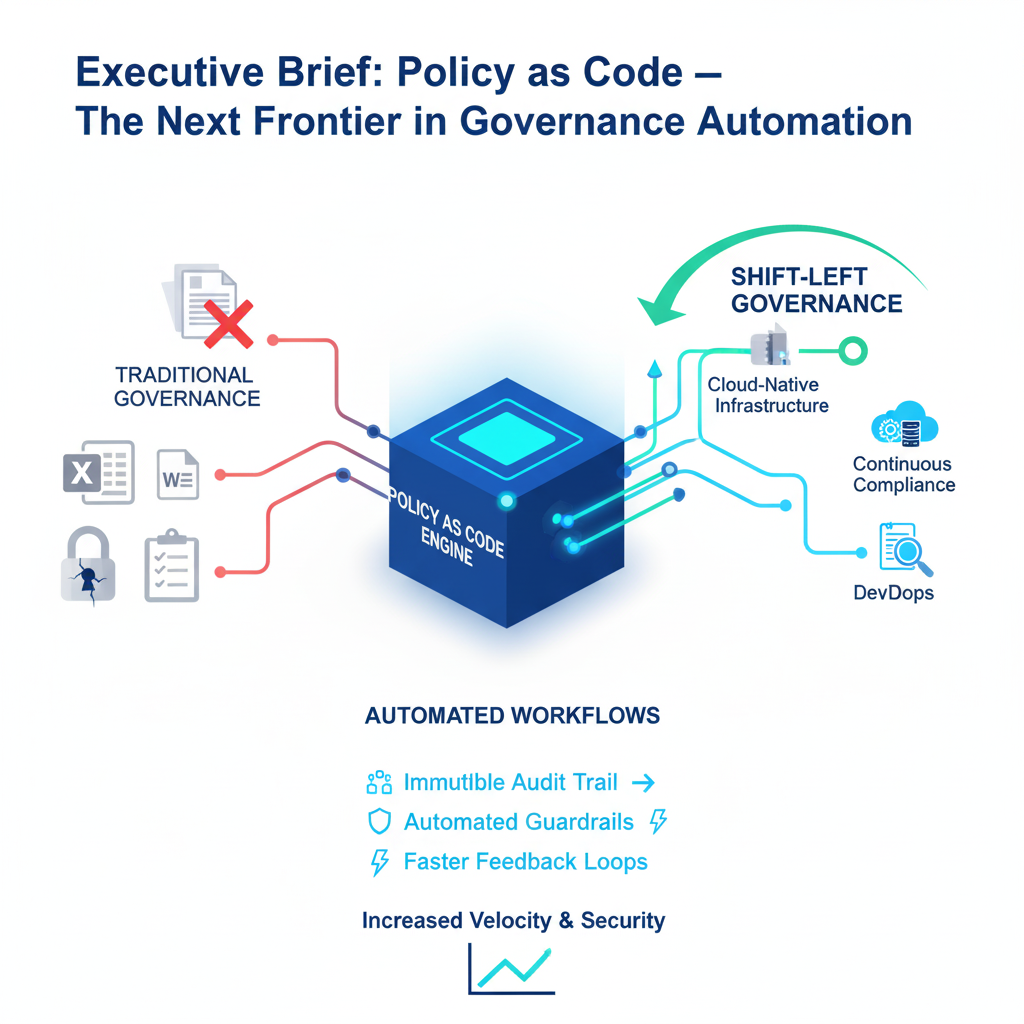
Policy as Code transforms static compliance documents into executable logic. Policies become machine-readable and enforceable, enabling continuous validation, version control, and real-time auditability. This means every change, from infrastructure configuration to data handling, is checked against defined policies before deployment.
- Declarative & versioned: Policies live in source control, reviewed and updated like any other code artifact.
- Pipeline-integrated: Policy checks run automatically within CI/CD workflows.
- Continuous enforcement: Violations are detected early (“shift-left”) and remediated faster.
- Auditable by design: Compliance evidence is built into system logs and policy evaluations.
🌐 Industry Drivers and Trends
Several market forces are accelerating the move toward codified governance. Enterprises are adopting PaC to reduce compliance bottlenecks, enhance audit readiness, and align risk controls with automation goals.
| Driver | Implication |
|---|---|
| Faster release cycles | Manual compliance can’t scale with continuous delivery; automation is essential. |
| Regulatory pressure | Governments are exploring “rules-as-code” mandates to standardize policy enforcement. |
| Security & risk management | Codified rules reduce drift, misconfigurations, and human error. |
| Audit efficiency | Evidence generation becomes automatic and verifiable. |
| Operational agility | Policy updates roll out instantly across all environments. |
🏢 Strategic Benefits for Executives
- Consistency: Uniform governance across multi-cloud and hybrid systems.
- Agility: Policies evolve as fast as applications, enabling compliance at velocity.
- Efficiency: Reduced audit fatigue and compliance cost.
- Transparency: Real-time visibility into policy adherence.
- Competitive Advantage: Governance becomes an enabler, not a blocker.
⚙️ Adoption Roadmap
- Policy Assessment: Identify the most critical or repetitive compliance rules suitable for codification.
- Select Tooling: Adopt frameworks like Open Policy Agent (OPA), Kyverno, or OSCAL that align with DevSecOps pipelines.
- Pilot Implementation: Start small with data access or network segmentation controls.
- Central Repository: Store, version, and review policies just like application code.
- Expand & Integrate: Gradually scale to organization-wide enforcement, connecting to dashboards and audit systems.
- Culture & Training: Bridge the gap between policy, security, and engineering teams through cross-discipline collaboration.
⚠️ Challenges & Risks
- Initial setup complexity: Translating human-readable policies into executable logic requires time and expertise.
- Policy governance: Policies themselves need maintenance, testing, and oversight.
- Tool fragmentation: Standards are still evolving, requiring integration across ecosystems.
- Cultural alignment: Success depends on cooperation between legal, compliance, and engineering functions.
🏁 From Compliance Burden to Competitive Advantage
The shift to Policy as Code isn’t just a technical upgrade — it’s a transformation of mindset. When compliance becomes continuous, organizations gain not only speed and accuracy but also confidence in every release. Policy as Code transforms governance from a static burden into a living, adaptive, and value-driving system.
For executives, adopting Policy as Code is a signal of maturity — a commitment to governance that scales with innovation.